Synchronous Transmission
In synchronous DTE/DCE interface operation, the modem determines bit sampling
times from a separate clock signal, which is usually sent from the DCE to
the DTE. Two clock signals are required; one for transmitted data and one
for receive data. Octet boundaries require a suitable protocol, such as
HDLC, this provides special octets whose presence identifies octet boundaries.
In HDLC these special octets are called flags.
Most modem line signals are synchronous. Bit timing information is inherent
in the modulation and is extracted at the receiver so it can sample the
received signals at the correct times.
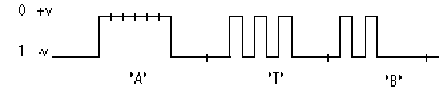
The following depicts an ASCII pulse train for the characters BAT. The train
is depicted for RS-232 coded signals.
Communication is managed through special protocols. Though techniques differ
slightly, synchronous protocols assemble data in frames prior to transmission
and disassemble the frames on arrival. If the communication environment
supports synchronous communication, the framing p; data formatting p;
is performed by the communications software. No data format selection is
required of the modem for synchronous operation.
Synchronous modes 1, 2, 3 and 4 are supported by standalone (external) modems.
Hayes board level (internal) modems support synchronous communications with
synchronous mode 4, Hayes AutoSync. The only exceptions are the modems designed
for the Apple Macintosh II family: Smartmodem 2400M and Vseries Smartmodem
2400M. The Macintosh II, unlike other personal computers, supports both
asynchronous and synchronous communications without an adapter card. If
a personal computer (an IBM PC XT, for example) has a synchronous adapter
card installed, then a Hayes standalone Smartmodem or Vseries product that
supports modes 1, 2, or 3, may be used for synchronous communications.
Click here to return to the Contents page.