Asynchronous Mode with Automatic Speed Buffering &Q6
Automatic Speed Buffering (ASB) is useful for computers and communication
programs that do not automatically adjust to changing transmission speeds.
ASB enables computer equipment to send and receive data to and from the
attached modem at one particular transmission speed, regardless of the speed
of the modem-to-modem connection. (If using a Hayes Smartcom product, ASB
is unnecessary; Hayes communications software adjusts to changing speeds
and connection types.)
When a V-series product cannot complete an error-control connection, it
attempts to establish an asynchronous connection (if in factory configuration).
When this occurs, the modem-to-computer (DTE) transmission speed may change,
however. To accommodate computers or computers running software that cannot
adjust to such a change, the local V-series product can be configured to
enable Automatic Speed Buffering when it has to fall back to asynchronous
communication. For negotiation failure treatments, see S36,
and the modem installation information for the options available to the
specific modem.
ASB buffers (stores) data temporarily, using local flow-control to parcel
it from the computer as the modem is ready to receive it. The modem must
be set with the &K command to use the appropriate DTE flow-control method.
When using ASB, the modem signals the local computer when to start and stop
sending data, depending on how full the modem buffer is. The factory setting
for flow-control is appropriate for most computers. However, in rare instances,
you may need to select another flow-control method. For example, if using
XON/XOFF flow control (&K4 setting) results in undesirable interactions
with user application software, then RTS/CTS (&K3) or transparent XON/XOFF
(&K5) are available.
To increase buffer size, change its upper limit by changing the setting
of S50 from its factory setting to a higher number in its range of 2-250
bytes. The value of the register reflects the number of bytes that can be
stored in the buffer before the modem signals the computer to stop sending
data. It is unlikely that the buffer lower limit, the level at which the
modem signals the local computer to resume sending data, would ever need
to be changed. However, this setting can be changed by writing to S49. If
these register values are set incorrectly or outside the acceptable range,
they are automatically adjusted by the modem for ASB to work.
If the modem receives a character while dialing the telephone number, it
aborts the call and sends the OK result code; if a character is received
after dialing but prior to the completion of the connection, it aborts the
call and sends the NO CARRIER result code.
For the responses associated with transitions of the DTR signal for this
mode, see the &D command.
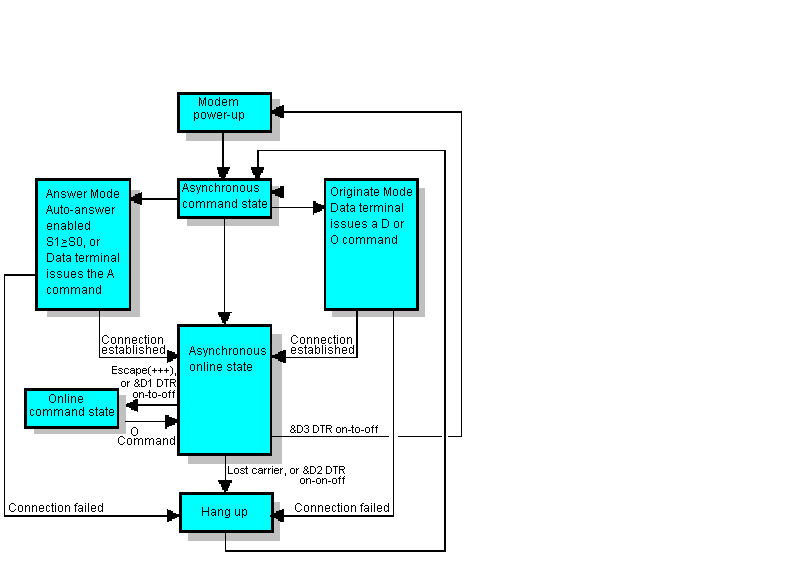
The following diagram depicts modem operation in asynchronous mode with
ASB.